
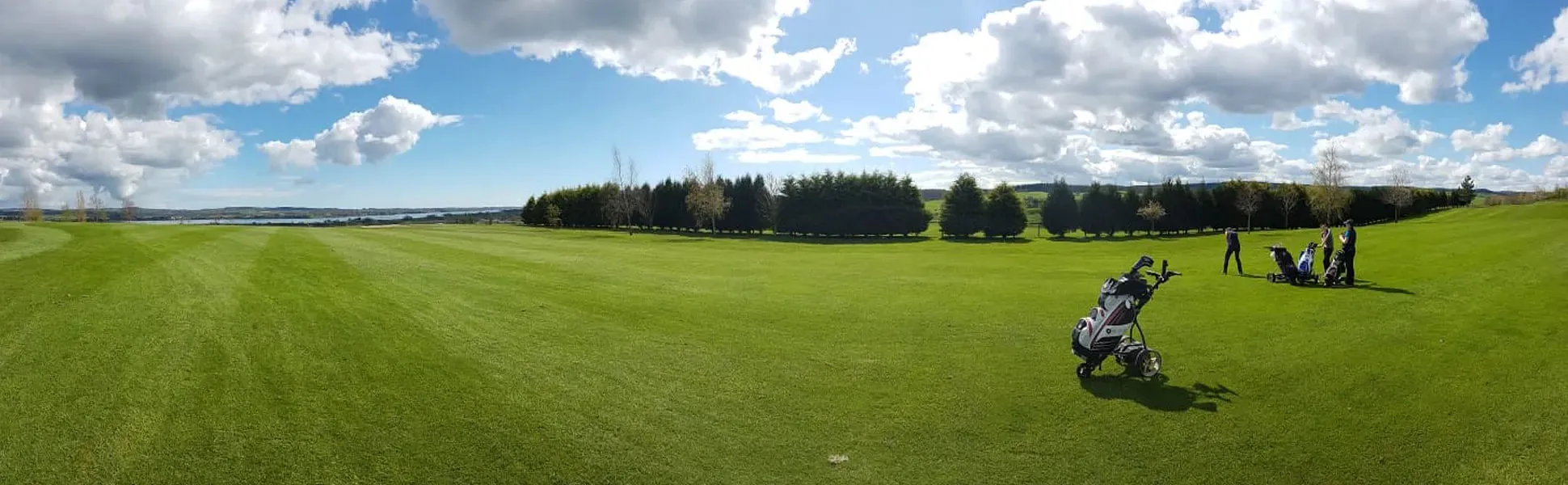
Most golfers treat the range as a place to hit a bucket of balls as hard and as fast as they can, then wonder why their scores never move. The truth is simpler, and a little uncomfortable: practice only lowers your scores when it looks something like the game you actually play. The good news is that small changes to how you use your time on the mats pay off quickly.
Here are ten driving range tips that translate directly into lower numbers on the card. Work through them on your next visit to our floodlit driving range, and you will start to feel the difference within a few sessions.
1. Warm up before you “practise”
Your first ten balls are not practice, they are a warm-up. Start with a wedge or short iron, make smooth half-swings, and gradually build length and speed. Cold, fast, full swings are how range sessions begin badly and how backs get tweaked. Give your body five minutes to wake up before you chase distance.
2. Always pick a target
This is the single biggest mistake we see. Hitting into open space teaches your brain nothing. Every shot should have a specific target: a flag, a yardage marker, a distant tree. On the course you never hit to “out there”, so do not train that way. Narrow your focus and your dispersion narrows with it.
3. Build a pre-shot routine and repeat it
Stand behind the ball, pick your target, choose an intermediate spot a foot or two ahead of the ball on that line, set the clubface, then set your feet. Do it on the range exactly as you would on the first tee. A repeatable routine is the closest thing golf has to a pressure-proofing tool, and it costs you nothing but discipline.
4. Check your alignment with clubs on the ground
Feeling aligned and being aligned are rarely the same thing. Lay one club along your toe line and another pointing at the target, and you will often be shocked at how far off you were. Alignment is the cheapest stroke-saver in the game, because poor aim forces compensations that wreck an otherwise good swing.
5. Vary your clubs, never rake-and-rake
Hitting forty seven-irons in a row builds a groove you cannot use, because you never hit the same club twice running on the course. Change clubs often. Better still, “play” a hole: driver, then a mid-iron, then a wedge. This forces your brain to reset for each shot, which is exactly what real golf demands.
6. Train tempo, not violence
Speed comes from sequence and rhythm, not from hitting harder. A useful drill is to swing at roughly 80% effort and notice how often the strike improves and the ball flies just as far. Counting a simple “one-and-two” through your swing keeps your transition smooth. Calm tempo under pressure is what separates good scores from blow-ups.
7. Practise with purpose: set a task and a score
Aimless ball-beating is comfortable but useless. Give every session a job. Try the “nine-ball game”: hit three trajectories with three clubs, low-mid-high, and grade yourself out of nine. Or set a three-metre-wide imaginary fairway and count how many drives land inside it. Adding a score creates consequences, and consequences create learning.
| Practice element | What most golfers do | What actually lowers scores |
|---|---|---|
| Targets | Hit into open space | Pick a specific flag or marker every ball |
| Club selection | 40 balls, one club | Change club every shot, play imaginary holes |
| Tempo | Swing as hard as possible | 80% effort, count your rhythm |
| Feedback | Watch ball flight only | Use alignment sticks and a scored game |
8. Spend a third of your time on the short game
The shots that ruin cards are not 250-yard drives, they are the fluffed chips and the three-putts. A large share of golf shots happen within 100 yards of the green, yet that is where amateurs practise least. Dedicate a serious chunk of every session to wedges, half-shots and distance control. It is the fastest route to lower scores. Our signature par-3 4th over the pond and the long, uphill par-5 8th on the course both reward a sharp short game.
9. Rehearse the awkward shots too
Because our range is floodlit and covered, you can train in the evenings and through winter when most players hibernate. Use that time to rehearse the shots you usually avoid: knock-downs into the wind, three-quarter wedges, awkward lies. The player who has hit a low punch a hundred times in February stays calm when the wind blows in July.
10. Get one lesson, then practise the right thing
The cruel irony of solo practice is that you can spend hours grooving a fault. A single session with a coach tells you what to work on, so your range time actually compounds. Our PGA Head Professional James Taverner runs golf lessons from £50 an hour, and a new indoor Golf Garage Swing Room studio opens in March 2026 for video and data-led coaching whatever the weather. Even one lesson can redirect months of practice.
Putting it together
You do not need more time on the range, you need better time. Warm up properly, aim at something, vary your clubs, protect your tempo, and give the short game the respect it deserves. Bring a notebook, score your drills, and treat each bucket as a rehearsal for the round to come.
When you are ready to test the work, book a tee time on our free-draining, all-year 9-hole course, or have a look at our pay & play green fees for a quick nine after work under the lights. Practise with purpose here, and the scores will follow.